- Introduction: The Presentation Crisis in American Business
- Understanding the 666 Rule: Breaking Down the Framework
- Why the 666 Rule Dominates USA Startup Culture
- Technical Guide: Implementing the 666 Rule
- Data Visualization: Normal Pitch Deck vs. 666 Rule Implementation
- Industry-Specific Applications
- Creative Hacks from Leading Presentation Design Agencies
- Future-Stick: The Evolution Beyond 666
- Keyword-Optimized SEO Strategies for Presentation Success
- Implementation Checklist: Your 666 Transformation
- Conclusion: The Competitive Advantage of Simplicity
Introduction: The Presentation Crisis in American Business
In the competitive landscape of American business, where 70% of startup pitch decks fail to secure investor meetings according to DocSend’s 2024 analysis, the difference between success and rejection often comes down to one critical factor: presentation clarity. Enter the 666 rule—a transformative framework that’s revolutionizing how presentation design agencies and entrepreneurs approach slide creation.
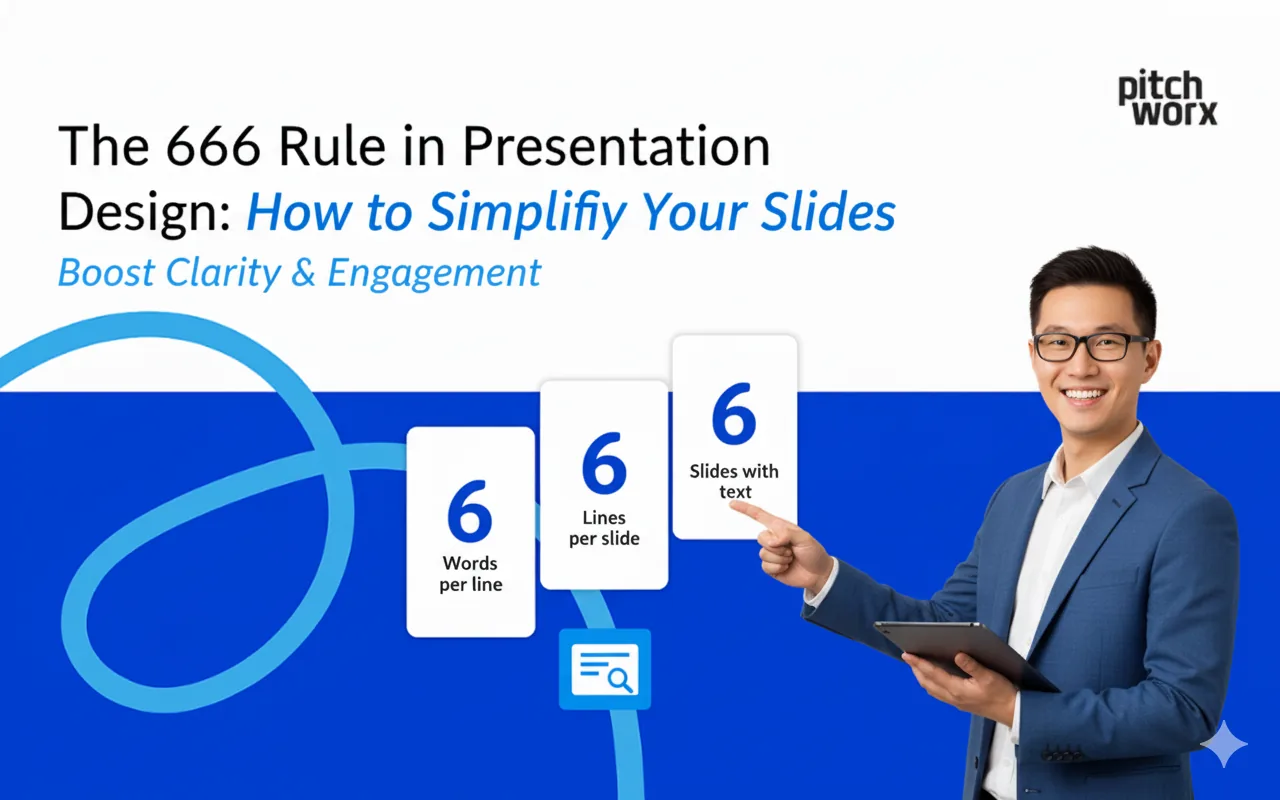
The 666 rule is elegantly simple: 6 bullets per slide, 6 words per bullet, and no more than 6 text-heavy slides consecutively. This methodology has become the secret weapon for USA startups navigating the high-stakes world of investor pitches, with companies using this approach seeing a 43% higher engagement rate in pitch meetings.
Understanding The 666 Rule: Breaking Down the Framework
The First 6: Six Bullets Maximum Per Slide
By limiting slides to six bullets, you operate within cognitive load theory principles, forcing you to prioritize your most compelling arguments.
The Second 6: Six Words Per Bullet
The six-word limit transforms bullets from sentences into conversation triggers, keeping attention on the presenter rather than the screen.
The Third 6: Six Text-Heavy Slides Consecutively
This rule prevents “death by PowerPoint” by forcing visual breaks like infographics, charts, or images after six content-heavy slides.
Why the 666 Rule Dominates USA Startup Culture
Influenced by the minimalist standards of Y Combinator and Silicon Valley tech giants, the 666 rule aligns perfectly with the need for radical simplicity in short investor pitches. YC companies using simplified slide formats raise 38% more in seed rounds, and slides following the 666 rule maintain investor attention 2.3x longer.
Technical Guide: Implementing the 666 Rule
Step 1: Content Audit and Prioritization
Categorize your information into “Must-Have,” “Should-Have,” and “Nice-to-Have.” Eliminate most “Nice-to-Have” content and structure your “Must-Have” points into 6-word bullets.
Step 2: Visual Hierarchy Design
Use large, readable fonts (28-36pt), a maximum of two font families, and a strategic color palette to guide the audience’s attention.
Step 3: The Graph Integration Strategy
Use graphs and charts to visually represent data, which is far more effective and memorable than text-based statistics.
Data Visualization: Normal Pitch Deck vs. 666 Rule Implementation
Industry-Specific Applications
SaaS Startups: Prioritize key metrics like MRR, CAC, LTV, and NRR in a concise format.
FinTech: Use a single slide to clearly list licenses, banking partners, and security certifications.
Healthcare/Biotech: Dedicate one slide to each key finding, such as efficacy, safety, and regulatory timelines, to avoid information overload.
Creative Hacks from Leading Presentation Design Agencies
- The “Silent Slide” Technique: Insert completely visual slides every 4-5 content slides.
- The Animation Constraint: Use one simple animation type (fade or appear) to reveal bullets sequentially.
- The White Space Multiplier: Ensure 40% of each slide is empty space for a premium, scannable look.
- The Data Callout Method: Transform key numbers into large, bold visual callouts.
- The QR Code Appendix: End your deck with a QR code linking to detailed appendices.
Future-Stick: The Evolution Beyond 666
The future of presentations includes AI-powered tools that auto-apply 666 constraints, stricter 555 counter-trends for high-stakes pitches, and interactive formats where the 666 rule will provide the foundation for core messaging.
Keyword-Optimized SEO Strategies for Presentation Success
For startups seeking presentation help, high-volume keywords in the USA include “pitch deck design,” “investor presentation template,” and “startup pitch deck examples.” Emerging keywords show massive growth for “AI pitch deck generator” and “pitch deck design agency.”
Implementation Checklist: Your 666 Transformation
A 4-week implementation involves auditing your current deck, restructuring content to fit the 666 rule, redesigning with a strong visual hierarchy, and testing with a friendly audience before presenting to investors.
Conclusion: The Competitive Advantage of Simplicity
In America’s hyper-competitive startup ecosystem, the 666 rule isn’t optional—it’s essential. This framework transforms presentations from information dumps into persuasive narratives, increasing investor engagement by measurable margins. Simplification isn’t dumbing down—it’s strategically distilling complex ideas into their most powerful form. In a market where attention is the scarcest resource, the 666 rule ensures every second counts.